How Directional Drilling Works in Richmond Ground
The fall line, downtown
Richmond exists because ships stopped at the rapids: the fall line — the seam where the hard piedmont meets the soft coastal plain — runs through the city itself, and everything about local drilling follows from which side of it an alignment sits. West: granite and gneiss under a weathering profile of saprolite, the crumbly transition rock that drills easily until it doesn't, with fresh-rock depth changing lot by lot. East: the coastal plain's marine package — sands, clays, and the shell-rich marls of ancient seafloors — soft, wet, and honest about it. Downtown itself is the seam, where a single alignment can taste both worlds. Two-ground quoting names the side, prices the classes, and lets geotech turn the boundary from a regional line into your project's map.
Virginia's permit map: cities without counties, counties without county roads
Two Virginia facts organize every crossing here. First, independent cities: Richmond and its siblings belong to no county, so their streets run on their own ROW processes with no county layer at all. Second, VDOT's reach: in the counties, the state maintains nearly all public roads — the land-use permit is the default crossing paper — with Henrico's self-maintained system the notable local exception. Add the interstates' district review and the CSX corridor's own permitting, and the metro's permit geometry is unlike any other state's. Our scope sheets ask the city-or-county question first because everything else follows from it.
The sequence, capital edition
The bones are standard — locates plus private designating, potholes on every claimed utility, pilot on profile, ream to about one and a half times the product, pull, restore. Richmond bends: saprolite-to-rock tooling staged on west-side shots, wet-sand and marl manners on east-side shots, erosion-and-sediment control run to Bay-watershed seriousness, historic-district and tree-ordinance rules honored where the old city's streets demand it, and restoration to standards set by neighborhoods that have looked good for two centuries.
Who owns what you're crossing
Independent cities own their streets outright; VDOT owns most county pavement, Henrico excepted; the interstates run on VDOT district review. The James brings state waterway and Bay-watershed authorities, navigation interests on tidal reaches, and the park system's stewardship through the city; the Appomattox and the tributaries carry the same logic smaller; CSX and the port permit their corridors. The quote names every owner on your alignment — and in this metro, the address alone usually names the first one.
Straight answers
Will you hit rock on my bore?
West of the fall line, plan for the possibility — saprolite over granite with fresh-rock depth keeping its own schedule; east of it, rock is rarely the question and water usually is. The quote names your side and your classes, and a soil boring turns the regional answer into your parcel's answer.
How deep do bores run under Richmond streets?
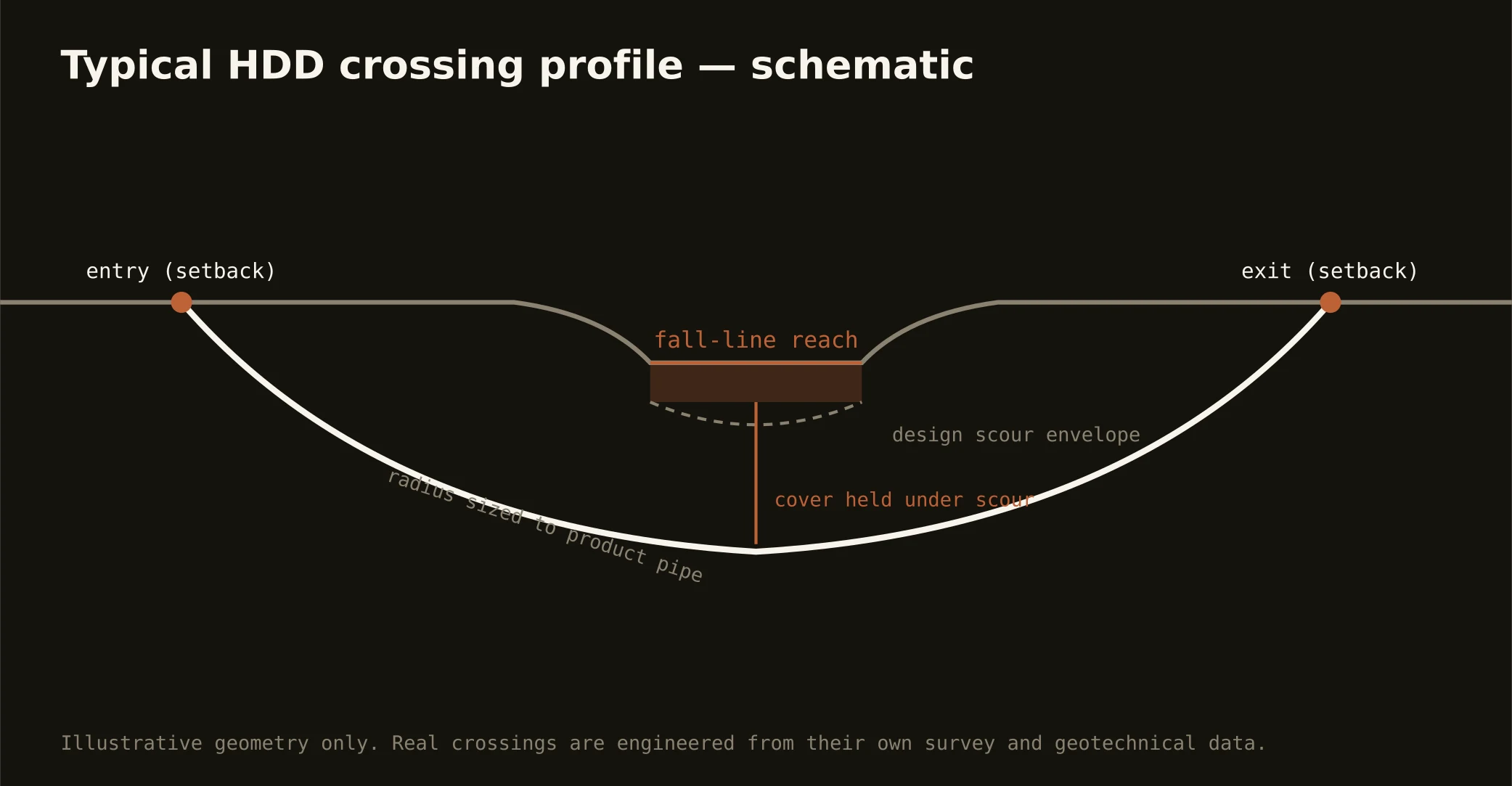
Cover follows the owning authority's standard — city or VDOT — and sits below everything potholed on the alignment; river crossings run to the reach's engineering. On the west side depth can change the geology mid-bore, so the plan states both the number and the expected ground at it.
Is drilling in the historic districts different?
The method is why it's allowed: HDD passes under brick sidewalks, tree roots, and streets the districts protect, with pits sited to the rules and restoration to the neighborhood's standard. The permit layers are real and the quote carries them; the districts' seriousness about their streetscapes is exactly why bores beat trenches here.
Ready to put a number on a real crossing? Send the scope — a person prices it.